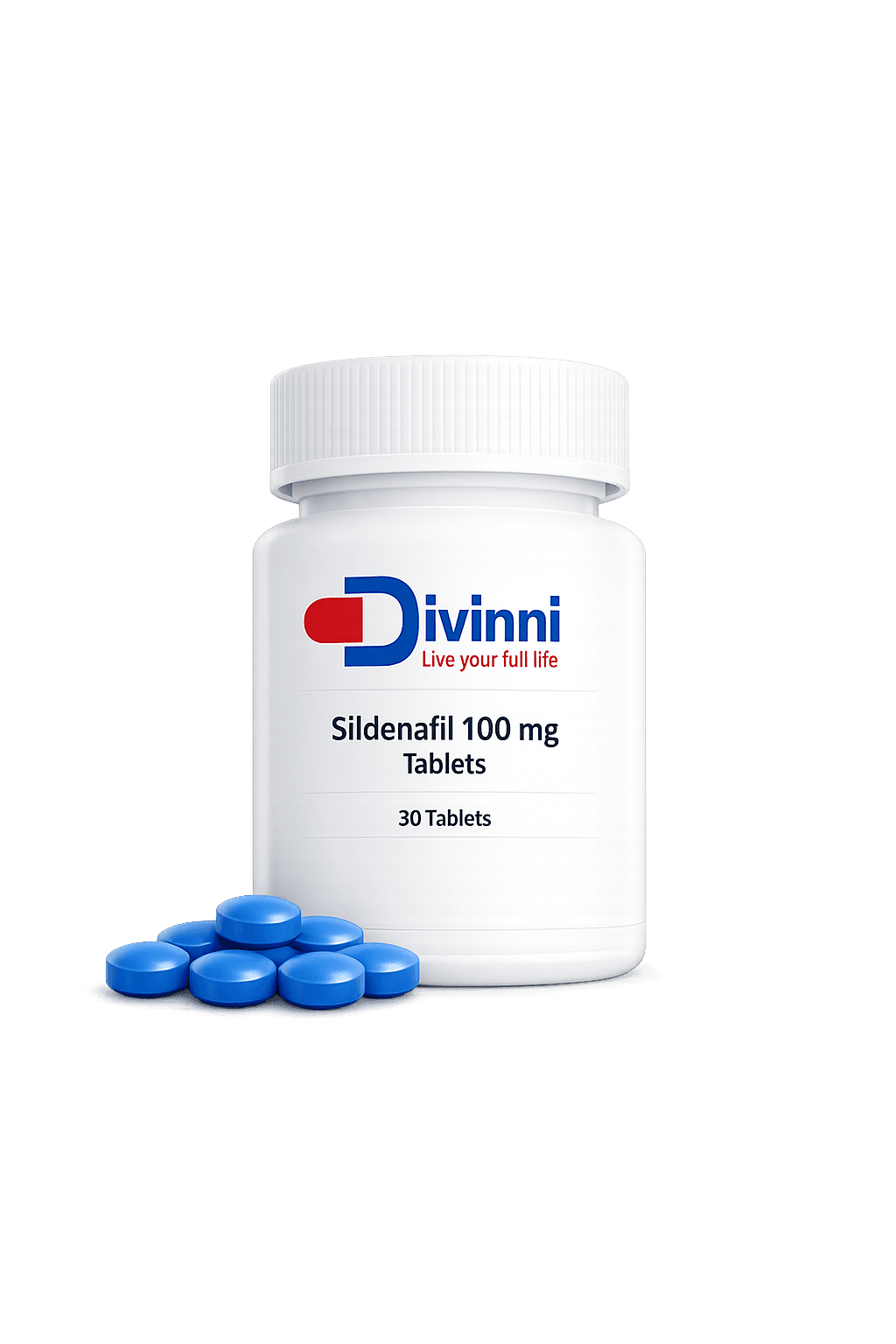
When sildenafil citrate — marketed as Viagra — received U.S. FDA approval on March 27, 1998, it launched a cultural and medical revolution. For the first time, millions of men with erectile dysfunction (ED) had access to a simple, oral, on-demand treatment.
Over 25 years later, sildenafil remains the most recognized and one of the most prescribed phosphodiesterase type 5 (PDE5) inhibitors globally. While newer agents like tadalafil offer extended duration, sildenafil retains distinct advantages in onset, potency, and a well-characterized safety profile.
This article reviews how sildenafil works, its clinical effects, satisfaction rates from large-scale real-world studies, and essential safety considerations.
The Mechanism of Action: Precision Targeting of PDE5
Penile erection depends on cyclic guanosine monophosphate (cGMP). Sexual stimulation triggers nitric oxide (NO) release in the corpus cavernosum, activating guanylate cyclase and producing cGMP — which relaxes smooth muscle and dilates arteries. Phosphodiesterase type 5 (PDE5) naturally breaks down cGMP, limiting erection duration.
Sildenafil is a potent, selective PDE5 inhibitor. By slowing cGMP degradation, it sustains smooth muscle relaxation and blood flow. Critically, sildenafil is not an aphrodisiac — it requires sexual stimulation to initiate NO release. Without stimulation, there is no cGMP for sildenafil to preserve.
Research established PDE5 as the dominant PDE activity in human corpora cavernosa. Sildenafil's mean IC50 is approximately 0.0039 μM — roughly 500 times more potent than the older inhibitor zaprinast — with selectivity over PDE1, PDE3, and PDE4 underpinning its efficacy with relatively few off-target effects.
- Sildenafil blocks the PDE5 catalytic site and stimulates cGMP binding to allosteric sites without competing with cGMP.
- Site-directed mutagenesis identified key residues (Tyr602, His607, His643, Asp754) critical for sildenafil binding within the PDE5 catalytic domain.
Pharmacokinetics: The "On-Demand" Profile
Sildenafil's pharmacokinetic profile defines its role as an on-demand treatment for planned sexual activity — a predictable, relatively short window of action compared to tadalafil's 36-hour duration.
Sildenafil is rapidly absorbed with mean absolute bioavailability of 41% (25%–63%). In the fasted state, peak plasma concentrations occur within 30–120 minutes, with median Tmax of approximately 60 minutes.
Terminal half-life is approximately 4 hours for both parent drug and active metabolite N-desmethyl sildenafil. The drug is ~96% protein-bound and eliminated primarily via hepatic CYP3A4 metabolism.
- High-fat meals delay Tmax by a mean of 60 minutes and reduce Cmax by 29% — take on an empty stomach or at least 2 hours after eating for optimal results.
Satisfaction and Efficacy Data: What the Numbers Show
A landmark 2025 European Urology Focus study analyzed over 130,000 patients from a direct-to-consumer telemedicine platform — among the largest real-world PDE5 inhibitor comparisons to date. At intermediate/high doses (sildenafil 50/100 mg vs. tadalafil 10/20 mg), sildenafil showed significantly higher patient-reported improvements in satisfaction, hardness, and erection maintenance.
A separate 2025 randomized controlled trial (12 weeks) found daily tadalafil superior to on-demand sildenafil across multiple domains including depression and anxiety — highlighting that trial populations and protocols can yield different conclusions than real-world usage.
Real-World Outcomes: Sildenafil vs. Tadalafil (130,000+ Patients, 2025)
| Outcome Measure | Sildenafil (50/100 mg) | Tadalafil (10/20 mg) | Significance |
|---|---|---|---|
| Patient satisfaction improvement | Mean change 2.534 ± 1.3 | Mean change 2.235 ± 1.4 | p < 0.0001 |
| Sexual performance (hardness) | Mean change 2.245 ± 1.2 | Mean change 2.105 ± 1.3 | p < 0.0001 |
| Erection maintenance | Mean change 2.264 ± 1.2 | Mean change 2.120 ± 1.3 | p < 0.0001 |
Formulation Innovations and Satisfaction
A 2025 International Journal of Impotence Research study compared sildenafil oral suspension (OSF) to oro-dispersible film (ODF) in 70 men with mild-to-moderate ED. Both improved IIEF-EF scores significantly (p < 0.01), but OSF showed higher overall satisfaction, PGI-I improvement, and PAIRS-SF spontaneity scores.
- IIEF overall satisfaction significantly higher with OSF than ODF (p < 0.001).
- PGI-I scores better with OSF (p < 0.001); PAIRS-SF spontaneity higher with OSF (p < 0.01).
- Predictors of improved OSF satisfaction: younger age (p = 0.02) and lower baseline IIEF-EF (p = 0.01).
Safety Profile and Adverse Events
Sildenafil is generally well-tolerated with predictable vasodilatory side effects. In the 130,000-patient study, overall adverse event rates were similar between sildenafil (35.0%) and tadalafil (33.9%, p = 0.1424). Nasal congestion was most common across all PDE5 inhibitors.
Common Adverse Reactions (FDA Labeling, ≥2% Incidence)
| Adverse Reaction | Incidence |
|---|---|
| Headache | Most common |
| Flushing | >10% in some studies |
| Dyspepsia | >10% in some studies |
| Nasal congestion | >10% in some studies |
| Abnormal vision | 2–10% |
| Back pain / myalgia | 2–10% each |
| Nausea / dizziness / rash | 2–10% each |
Comparative Safety and Serious Risks
- Sildenafil less likely to cause reflux than tadalafil (5.3% vs. 8.0%, p < 0.0001); more associated with flushing (7.3% vs. 2.3%, p < 0.001).
- Absolute contraindications: nitrates (including poppers), guanylate cyclase stimulators (e.g., riociguat), and known hypersensitivity.
- Mean maximum supine BP decrease of 8.4/5.5 mmHg in healthy volunteers — use caution with cardiovascular disease.
- Priapism (>4 hours): seek immediate care; untreated priapism can cause permanent tissue damage.
- NAION risk approximately 2-fold with PDE5 inhibitors (annual incidence 2.5–11.8 per 100,000 males ≥50).
- Stop sildenafil and seek care for sudden hearing loss.
The Bottom Line: Is Sildenafil Right for You?
Sildenafil remains a first-line ED treatment with over two decades of clinical experience. The choice between sildenafil and tadalafil often comes down to lifestyle and preference.
- Choose sildenafil if you prefer potent on-demand effect, can plan 30–60 minutes ahead, and take on an empty stomach for best results.
- Choose sildenafil if you value the longest track record and real-world data showing slightly higher hardness and maintenance scores.
- Consider tadalafil if you want spontaneity (24–36 hour window), daily dosing, or dual BPH indication.
- Consider alternatives if you experience visual disturbances with sildenafil or need continuous readiness without planning.
- Never use sildenafil with any form of nitrate medication.
Conclusion
Sildenafil launched the modern era of ED treatment and remains a globally recognized first-line option. Its on-demand pharmacokinetics, molecular selectivity for PDE5, and extensive real-world data support continued use — particularly for men who prefer planned, high-efficacy encounters.
Large-scale telemedicine data suggest sildenafil may outperform tadalafil on satisfaction and hardness at medium/high doses, while controlled trials sometimes favor daily tadalafil — underscoring that patient preference and lifestyle matter as much as pharmacology.
As with all PDE5 inhibitors, sildenafil requires a prescription and cardiovascular evaluation. Obtain it only through legitimate pharmacies with proper medical oversight.
Sources
- ScienceDirect. Inhibition of Cyclic GMP-Binding Cyclic GMP-Specific Phosphodiesterase (Type 5) by Sildenafil and Related Compounds. 2025.
- MedLibrary.org. Sildenafil (Northwind Health Company, LLC): FDA Package Insert. 2025.
- European Urology Focus. Head-to-head Comparison of PDE5 Inhibitors in 130,000 Patients. 2026.
- NIH DailyMed. Sildenafil Tablet Prescribing Information (Aurobindo Pharma). 2025.
- PubMed. Sildenafil: an orally active PDE5 inhibitor for ED. 1996.
- Nature/International Journal of Impotence Research. Sildenafil oral suspension vs. oro-dispersible film. 2025.
- NIH DailyMed. Sildenafil Tablets Highlights of Prescribing Information (Nivagen). 2025.
- PubMed. Comparative efficacy of on-demand Sildenafil, Tadalafil and daily Tadalafil. 2025.
- ScienceDirect. Sildenafil inhibition of PDE5 in human corpus cavernosum. 1998.
- Medikamio. Sildenafil — dosage, effect, side effects.