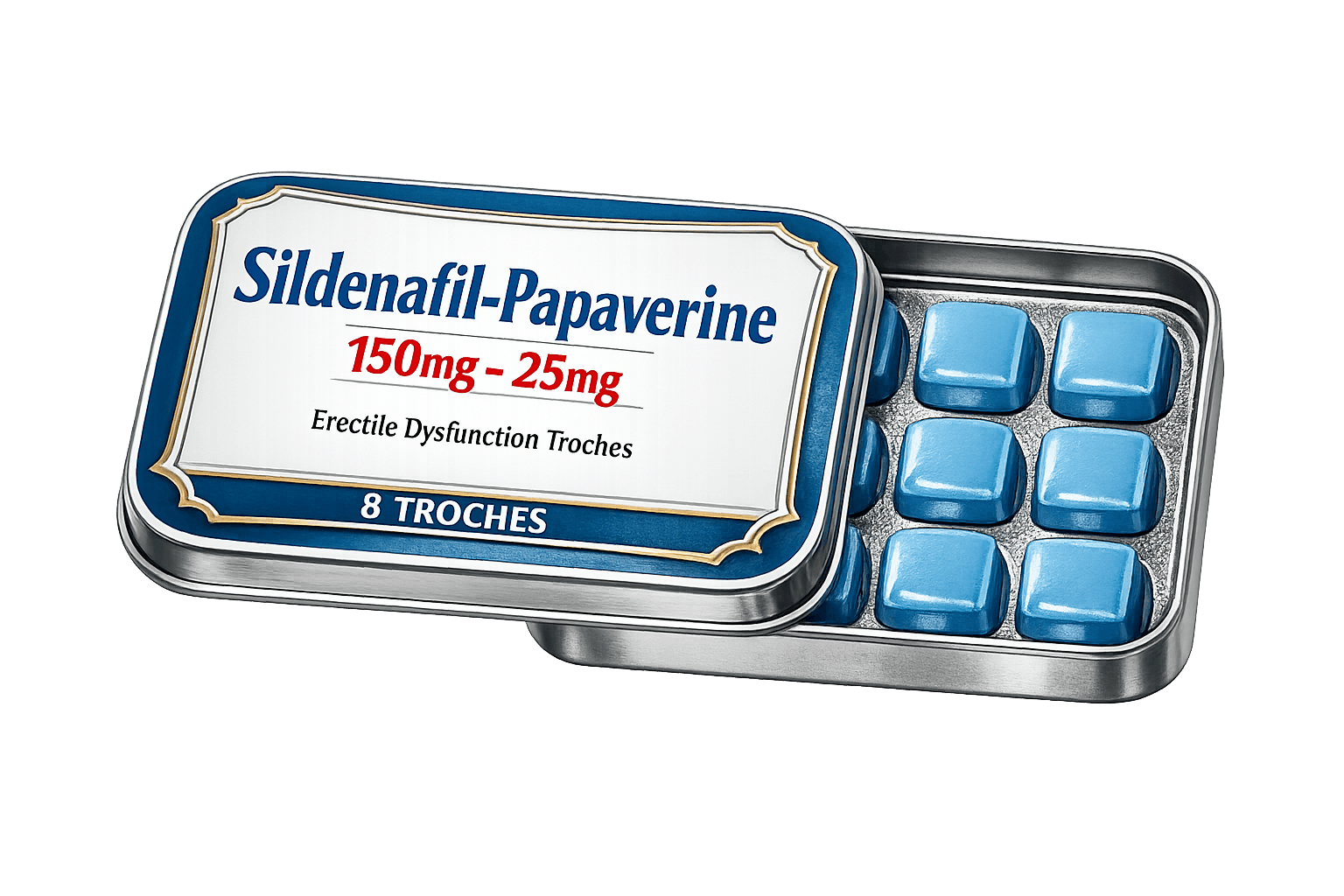
For men who find that standard oral medications for erectile dysfunction (ED) provide insufficient results, the search for an alternative can be frustrating. Enter the sildenafil plus papaverine troche — a compounded formulation that combines two complementary vasodilators in a convenient, dissolvable delivery system.
This article explores the pharmacological basis for this combination, the unique benefits of the troche format, and the clinical evidence supporting dual-mechanism therapy.
Part I: The Components — Two Pathways, One Goal
Penile erection depends on relaxation of smooth muscle in the corpus cavernosum. Two intracellular messengers — cyclic guanosine monophosphate (cGMP) and cyclic adenosine monophosphate (cAMP) — orchestrate this relaxation. Sildenafil and papaverine target these messengers through distinct mechanisms, creating a synergistic effect.
Sildenafil selectively inhibits phosphodiesterase type 5 (PDE5), preventing cGMP breakdown and prolonging smooth muscle relaxation. Critically, sildenafil requires sexual stimulation — it amplifies the natural nitric oxide response rather than initiating erection on its own.
Papaverine is a non-selective phosphodiesterase inhibitor, blocking multiple PDE enzymes including PDE3 and PDE4 involved in breakdown of both cGMP and cAMP. Unlike sildenafil, papaverine can induce erection independent of sexual stimulation — the property that made intracavernosal papaverine one of the first effective pharmacologic ED treatments.
The Synergy Explained
| Agent | Primary Target | Arousal Required | Mechanism |
|---|---|---|---|
| Sildenafil | PDE5 (selective) | Yes | Prevents cGMP breakdown |
| Papaverine | PDE3, PDE4 (non-selective) | No | Prevents cAMP and cGMP breakdown |
Part II: The Troche Advantage — Beyond the Pill
A troche is a soft, flavored lozenge designed to dissolve in the mouth — placed between the cheek and gum or under the tongue for absorption through the oral mucosa rather than swallowing.
- Bypassing first-pass metabolism: sublingual/buccal absorption enters the bloodstream directly, potentially delivering more active drug at lower doses.
- Faster onset: standard sildenafil tablets peak around 60 minutes; troches are typically used 30–60 minutes before activity, with sublingual absorption potentially producing effects more rapidly.
- No water required: troches dissolve in saliva, offering discretion in spontaneous situations.
Part III: The Evidence — Does It Actually Work Better?
Important caveat: most large-scale clinical data for combined sildenafil-papaverine therapy comes from intracavernosal injection (ICI) studies, not troche studies. Pharmacological principles are similar, but absorption differs.
A 2003 prospective study examined patients using intracavernosal triple therapy (papaverine, phentolamine, and prostaglandin-E1) for over one year. When offered oral sildenafil alone, 75% responded — but 89% of responders reported better erection quality with their original injection therapy, with 74% citing better quality of erection as the main reason for preference.
Research on human prostatic tissue confirmed papaverine effectively reverses adrenergic tension in urogenital smooth muscle. Combined with sildenafil's PDE5 selectivity, this provides two layers of relaxation. For neurogenic ED, psychogenic ED with performance anxiety, or severe vascular ED with compromised nitric oxide production, papaverine's arousal-independent action may be clinically meaningful.
Part IV: Safety Considerations
Combining two vasodilators increases the risk of certain side effects and requires closer monitoring.
Sildenafil-papaverine troches are compounded medications — not FDA-approved as a fixed-dose combination. Quality varies between pharmacies, and no large-scale trials establish long-term troche safety. Use only reputable, licensed compounding pharmacies.
- Hypotension: both drugs lower blood pressure; combined use may produce additive effects.
- Dizziness and headache: common with PDE5 inhibitors, potentially more pronounced with dual therapy.
- Priapism: erections lasting more than 4 hours require immediate medical attention.
- Contraindicated with nitrates (life-threatening hypotension), severe cardiovascular disease where sexual activity is inadvisable, and known hypersensitivity to either component.
Part V: Who Should Consider This Combination?
- PDE5 inhibitor non-responders — up to 30% of men do not respond adequately to sildenafil alone; adding papaverine may salvage previously failed therapy.
- Men with neurogenic ED — papaverine can work when nerve damage limits nitric oxide release.
- Patients seeking faster onset — troche delivery may absorb more quickly than swallowed tablets.
- Men who dislike injections — oral troches offer combination therapy without intracavernosal needles.
Sildenafil-Papaverine Troche vs. Alternatives
| Feature | Sildenafil Alone | Papaverine Injection | Sildenafil + Papaverine Troche |
|---|---|---|---|
| Delivery | Oral tablet | Intracavernosal injection | Oral troche (dissolves in mouth) |
| Arousal required | Yes | No | Reduced (papaverine works independently) |
| Onset | ~60 min | ~5–15 min | ~30–60 min |
| Invasiveness | Low | High | Low |
| Efficacy in non-responders | N/A (primary treatment) | High | Potentially high |
| FDA approval | Yes | Yes (as single agent) | No (compounded) |
| Priapism risk | Low (~0.1%) | Higher (5–7% with papaverine alone) | Moderate |
Conclusion
Sildenafil-papaverine troches offer a theoretically sound approach: combining selective PDE5 inhibition with non-selective PDE inhibition for more complete smooth muscle relaxation, delivered in a convenient troche format with potentially faster absorption.
The clinical reality is more nuanced. While the combination has proven effective in injectable form — with experienced patients often preferring it to sildenafil alone — the troche formulation lacks large-scale trials definitively establishing superiority over standard oral therapies. The primary advantage may be for PDE5 non-responders, men with neurogenic ED, or those seeking reduced dependence on arousal.
For the right patient under proper medical supervision, this represents a valuable next step after simpler approaches fail. Sildenafil-papaverine troches require a prescription, must come from licensed compounding pharmacies, and patients must be screened for cardiovascular contraindications — particularly nitrate use. Priapism risk, while lower than injectable papaverine, remains a concern requiring patient education.
Sources
- Sildenafil+Papaverine Troches product information. Pipeline Medical.
- Drug interaction data: papaverine and sildenafil. Drugs.com.
- Uckert S, et al. Characterization of PDE isoenzymes of the human prostate. J Urol. 2001.
- Kim SC, et al. Preference for oral sildenafil or intracavernosal injection. BJU Int. 2003.
- Lue T, et al. Comparison of oral and intracavernosal vasoactive agents. Int J Impot Res. 2000.
- Three-year outcome of progressive treatment program. EM consulte.
- Molecular mechanism of penile smooth muscle relaxation. NIH/PMC.