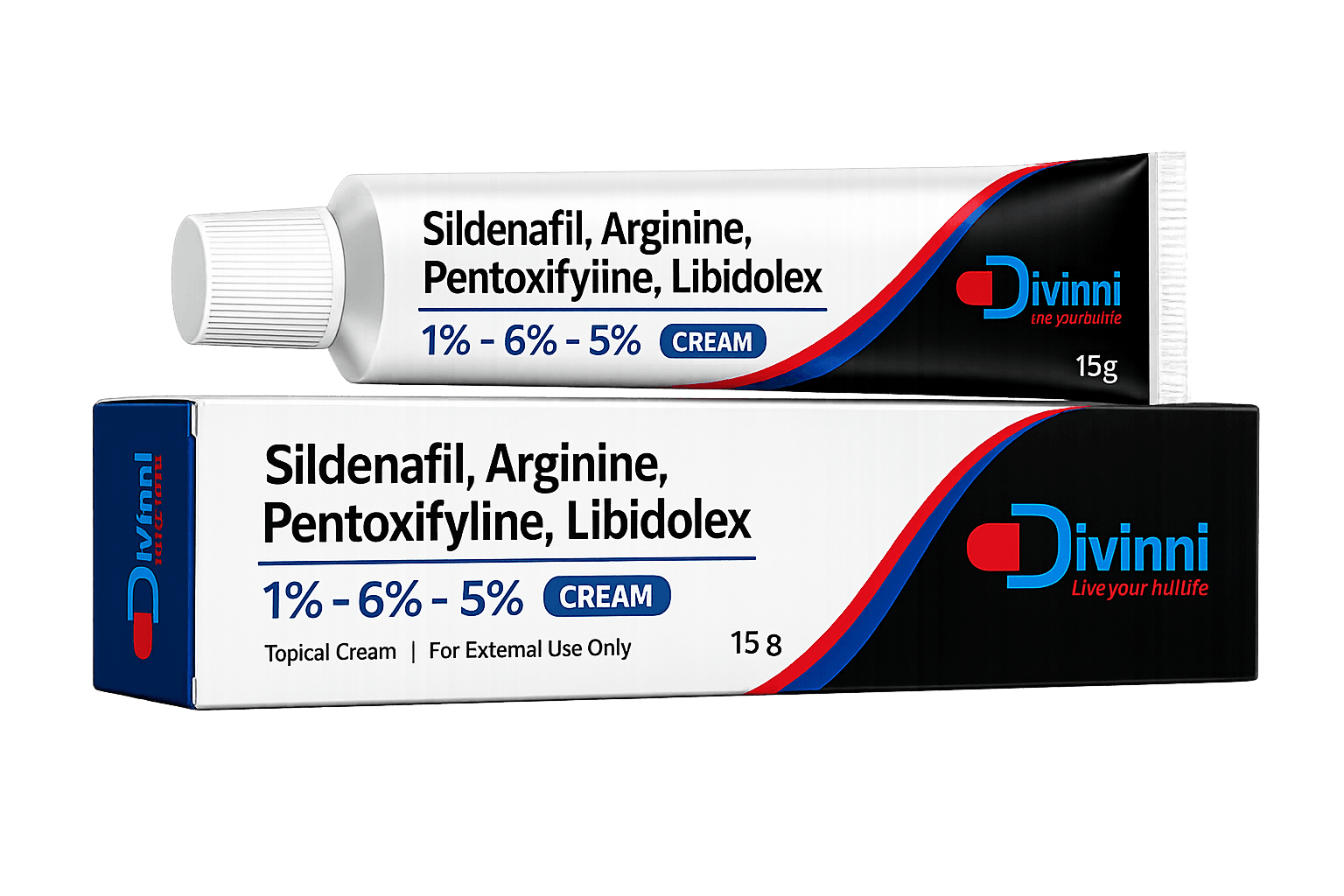
For decades, oral medications like Viagra have been the standard of care for erectile dysfunction. But what if the same active ingredient could be delivered directly where it is needed, bypassing the digestive system entirely?
This is the premise behind topical creams containing sildenafil, arginine, and pentoxifylline. This article examines how this combination works and whether it offers advantages over traditional oral therapy.
Part I: The Components — Three Mechanisms, One Goal
Sildenafil selectively inhibits PDE5, preventing cGMP breakdown and prolonging smooth muscle relaxation in penile tissue. In cream form, it is designed to act locally — particularly at the glans, which lacks the stratum corneum and has highly permeable mucosal epithelium ideal for topical delivery.
L-arginine is the primary substrate for nitric oxide (NO) production. Applied topically, it stimulates local NO formation; combined with sildenafil, arginine supplies raw material for NO while sildenafil preserves the cGMP signal NO generates.
Pentoxifylline enhances microcirculation by reducing blood viscosity and improving red blood cell flexibility. As a non-specific cAMP-PDE inhibitor, it raises cAMP levels and may reduce collagen synthesis — complementing sildenafil's PDE5-specific cGMP elevation.
Part II: The Synergy — Why These Three Together?
Combined, these ingredients attack ED from multiple angles simultaneously — a multi-layered approach no single agent achieves alone.
Triple-Mechanism Synergy
| Component | Primary Target | Mechanism |
|---|---|---|
| L-Arginine | Nitric oxide production | Substrate for NO synthesis, initiating vasodilation |
| Sildenafil | PDE5 enzyme | Prevents cGMP breakdown, prolonging smooth muscle relaxation |
| Pentoxifylline | Microcirculation & cAMP | Enhances flow through small vessels; raises cAMP levels |
Part III: The Topical Advantage — Why Cream Over Pills?
- Bypasses first-pass metabolism: glans absorption avoids hepatic destruction and variable oral absorption.
- Reduced systemic side effects: pilot data show salivary sildenafil in low ng/mL range — limited systemic exposure vs. oral pills.
- Faster local onset: 2026 study reported model-derived Tmax ≈ 1.9 hours after glans application with detectable concentrations within hours.
- Arousal independence: direct vasodilator delivery may help neurogenic ED (diabetes, spinal injury, post-prostatectomy), psychogenic ED, and age-related NO decline.
Part IV: The Scientific Evidence
A 2026 International Journal of Pharmaceutics study evaluated topical sildenafil cream on the glans. Ex vivo bull glans tissue (histologically similar to human) showed moderate permeation (17.2 ± 1.61 µg/cm²) and substantial retention (382 ± 80.5 µg/cm²).
Human pilot (n = 8): after 50 mg cream to the glans, detectable salivary sildenafil rose then remained stable over 2–4 hours (ka = 1.20 h⁻¹, Tmax ≈ 1.9 h). Authors concluded findings support feasibility of a locally acting alternative to oral PDE5 inhibitors.
- Systematic review: L-arginine plus sildenafil improves blood flow and may prolong sildenafil's effect on erectile function.
- Pentoxifylline animal data (Peyronie's model): 80–95% plaque size reduction; increased penile cAMP, complementing sildenafil's PDE5 action.
Part V: Who Might Benefit From This Cream?
- PDE5 inhibitor non-responders (~30% of men): added NO substrate and microcirculation support may salvage failed oral therapy.
- Men with oral sildenafil side effects: headaches, flushing, dyspepsia — topical route may improve tolerability.
- Those seeking discreet, non-pill options: no water required; applied before intimacy.
- Vascular or neurogenic ED: direct tissue delivery when natural NO production is compromised.
Part VI: Important Caveats
- Not FDA-approved for male ED — typically a compounded prescription product without large-scale RCT data.
- 2026 topical sildenafil study was pharmacokinetic (n = 8), not an efficacy trial; combination cream lacks randomized controlled studies.
- Risk of local irritation, burning, or allergic reaction; compounded quality varies by pharmacy.
- Generally not insurance-covered and often more expensive than generic oral sildenafil.
Conclusion
Sildenafil, L-arginine, and pentoxifylline in topical cream form represent a scientifically rational ED approach — each targeting NO production, cGMP preservation, and microcirculation/cAMP enhancement in synergy.
Topical delivery offers genuine advantages: bypassing first-pass metabolism, reducing systemic side effects, and acting directly at target tissue. Early pharmacokinetic data support feasibility.
Patients should maintain appropriate expectations: this remains an unapproved compounded product without large efficacy trials. It is best considered for men who have failed or cannot tolerate oral PDE5 inhibitors, under physician guidance. For the right patient, this triple-mechanism cream may restore function by working with natural vasodilator pathways rather than overriding them.
Sources
- Sildenafil, L-Arginine, and Erectile Function. NIH/PMC. 2022.
- Topical Sildenafil for ED: Ex Vivo and Pilot Human Study. International Journal of Pharmaceutics. 2026.
- Pentoxifylline Mechanism in Topical Creams. Strut Health Blog.
- L-Arginine and Sildenafil Interaction. HealthTap. 2014.
- Pentoxifylline and Sildenafil Anti-Fibrotic Effects. Journal of Sexual Medicine.
- Topical Sildenafil Cream for FSAD. Thieme Group. 2024.
- Euphoria Scream Cream Ingredient Summary. Vital Path.
- L-Arginine Topical Delivery Patents. Justia Patents.