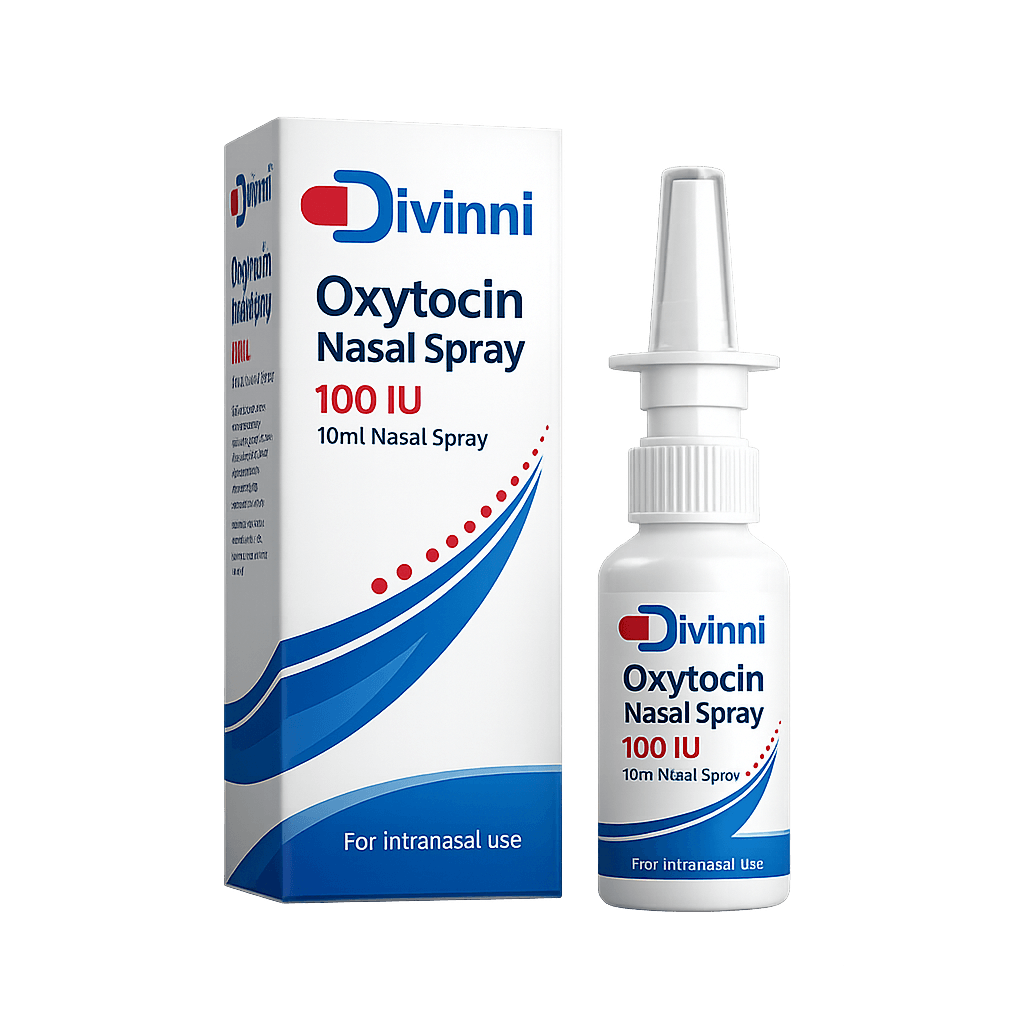
When most people think of treatments for erectile dysfunction (ED), they envision medications that work directly on blood vessels — PDE5 inhibitors like sildenafil (Viagra) or tadalafil (Cialis). But a fundamentally different approach has emerged from neuroscience research: the use of oxytocin nasal spray.
Known popularly as the "love hormone" or "cuddle chemical," oxytocin plays a natural role in bonding, trust, and sexual function. This article examines the scientific evidence for oxytocin nasal spray in treating ED, distinguishing between what animal studies suggest, what human trials have found, and where the research stands today.
Part I: What Is Oxytocin and Why Does It Matter for Male Sexual Health?
Oxytocin is a neuropeptide — a small protein-like molecule produced in the hypothalamus, a region deep within the brain. From there, it is released both into the bloodstream (acting as a hormone) and to other brain regions (acting as a neurotransmitter). For decades, oxytocin was known primarily for its roles in female reproduction: stimulating uterine contractions during childbirth and enabling milk ejection during breastfeeding.
However, research since the 1980s has revealed that oxytocin plays equally important roles in male sexual function. Studies in laboratory animals have consistently shown that oxytocin facilitates penile erection, copulatory behavior, and sexual motivation. In human males, oxytocin levels naturally rise during sexual activity, peaking at the moment of ejaculation.
- Penile erection — injecting small amounts of oxytocin into specific brain regions induces erections in male rats.
- Copulatory behavior — oxytocin enhances mounting, intromission, and ejaculation.
- Sexual motivation — animals become more willing to engage in sexual activity.
The Dual-Action Hypothesis
| Pathway | Target | Mechanism | Relevance to ED |
|---|---|---|---|
| Central (Brain) | Hypothalamus, spinal cord | Activates neural circuits controlling sexual motivation and ejaculation | Addresses libido and arousal |
| Peripheral (Body) | Testes, prostate, epididymis | Enhances androgen signaling and sperm quality | Supports hormonal and fertility aspects |
Part II: What the Animal Research Shows
The strongest evidence for oxytocin's pro-sexual effects comes from laboratory animal studies, particularly research published in 2025–2026 from Okayama University in Japan.
When researchers administered oxytocin intranasally to male rats, they observed significant activation of neurons in the paraventricular nucleus (PVN) of the hypothalamus — a brain region critical for male sexual behavior. Oxytocin-treated rats showed significantly enhanced pERK staining intensity in the PVN compared to controls.
Perhaps the most compelling finding came from sexually inactive male rats — animals that failed to ejaculate despite repeated opportunities. Oxytocin treatment significantly improved sexual activity, decreased mount and intromission latencies, and increased ejaculation frequency.
Sperm Quality Improvements After One Week of Daily Intranasal Oxytocin
| Parameter | Effect vs. Control | Statistical Significance |
|---|---|---|
| Sperm motility rate | Significantly higher | P < 0.001 |
| Progressive motility rate | Significantly higher | P < 0.001 |
| Sperm count | Significantly higher | P < 0.001 |
| Epididymal weight | Increased | P = 0.030 |
| Seminal vesicle weight | Increased | P = 0.018 |
| Prostate weight | Increased | P < 0.01 |
Part III: What the Human Research Shows — A More Complicated Picture
When researchers attempted to translate the promising animal findings to humans, the results became more nuanced. A 2023 systematic review analyzing six clinical trials concluded that intranasal oxytocin "fails to meaningfully affect the classical parameters of sexual response."
Oxytocin nasal spray did not produce statistically significant improvements in sexual drive, sexual arousal, penile erection, or vaginal lubrication across the reviewed studies.
However, the same review identified one area where oxytocin produced meaningful effects: orgasm and post-orgasmic dimensions, particularly in men — including increased orgasm intensity, contentment after intercourse, and sexual satiety.
2014 RCT Findings in Healthy Heterosexual Couples (29 couples)
| Domain | Effect of Oxytocin |
|---|---|
| Sexual drive / arousal | No significant change |
| Erection / lubrication | No significant change |
| Orgasm intensity | Increased (more pronounced in men) |
| Contentment after intercourse | Increased |
| Sexual satiety | Increased (men only) |
| Partner relaxation | Increased (women only) |
Part IV: A Unique Trial in Progress
The most definitive evidence on oxytocin for sexual dysfunction may come from an ongoing Phase 2 clinical trial at University Hospital Basel, Switzerland. The study, expected to complete in December 2026, is investigating whether intranasal oxytocin improves sexual well-being in patients with Arginine Vasopressin Deficiency (AVP-D).
- Participants: 42 patients in a randomized, double-blind, placebo-controlled cross-over design.
- Dose: 24 IU oxytocin nasal spray for 7-day treatment periods with 3-week washout.
- Endpoints: Sexual well-being, intimacy, pair bonding, sexual arousal, and empathy.
- Rationale: AVP-D patients frequently report decreased sexual desire despite adequate physical treatment — researchers hypothesize unrecognized oxytocin deficiency may be a factor.
Part V: The Paradox — Why Animal and Human Results Diverge
A major puzzle in oxytocin research is the discrepancy between robust positive findings in animals and equivocal results in humans. A 2021 review in the International Journal of Molecular Sciences noted that human studies do not appear to confirm the facilitatory role of oxytocin found in animal sexual behavior.
- Methodological differences in delivery — skepticism remains about how much intranasal oxytocin crosses the blood-brain barrier.
- Species differences in oxytocin receptor distribution and function.
- Study populations — most human trials use healthy volunteers with normal sexual function, creating a ceiling effect.
- Outcome measures — animal studies measure direct behaviors; human studies rely on self-report questionnaires.
Part VI: Special Populations — Promising Data in Opioid-Addicted Men
A 2025 randomized controlled trial examined 40 men with opioid dependence undergoing methadone maintenance therapy — a population with high rates of sexual dysfunction and infertility. Participants received either 40 IU oxytocin nasal spray daily (plus zinc supplementation) or placebo for two weeks.
Reproductive Improvements in Opioid-Addicted Men (Oxytocin + Zinc vs. Baseline)
| Parameter | Change vs. Baseline | Statistical Significance |
|---|---|---|
| Testosterone levels | +29.1% increase | P < 0.001 |
| Active sperm motility | Significant improvement | P = 0.015 |
| Total sperm abnormality | Significant reduction | P < 0.001 |
| Semen volume | Significant increase | P = 0.007 |
Part VII: Oxytocin vs. Conventional ED Treatments
Oxytocin Nasal Spray vs. PDE5 Inhibitors
| Feature | PDE5 Inhibitors (Viagra, Cialis) | Oxytocin Nasal Spray |
|---|---|---|
| Primary mechanism | Vasodilation (blood flow to penis) | Brain activation + hormonal effects |
| Effect on erections | Direct and reliable (70–80% success) | Not clearly demonstrated in human studies |
| Effect on libido | None | Potential (through central pathways) |
| Effect on orgasm | None | Improves intensity and satisfaction in some studies |
| Onset of action | 30–60 minutes | Unknown (effects studied after single dose) |
| Duration | 4–36 hours (varies by drug) | Unknown |
| Evidence base | Extensive (decades of RCTs) | Limited (few small studies) |
| FDA approval for ED | Yes | No |
| Fertility effects | None | May improve sperm quality (animal and limited human data) |
Part VIII: Safety, Side Effects, and Practical Considerations
Oxytocin nasal spray is generally well-tolerated. Side effects in clinical studies have been mild and transient, including transient heart rate increases during arousal and mild nasal irritation.
Oxytocin nasal spray is not FDA-approved for erectile dysfunction or any sexual disorder. Use for ED would be off-label. Caution is warranted in pregnancy, hyponatremia, and cardiovascular disease.
The positive results in the opioid-addicted population used oxytocin in combination with zinc supplementation. It is unclear whether oxytocin alone would have produced the same effects.
Part IX: The Bottom Line — What Should Men with ED Know?
Based on the available evidence, oxytocin nasal spray is promising but preliminary for overall sexual function — yet probably not a first-line ED treatment. Human studies have not demonstrated reliable improvement in erections, the core symptom of ED.
The most promising human data comes from men with opioid addiction, patients with hypothalamic-pituitary disorders (under investigation), and men whose primary complaints involve orgasm intensity or post-sexual satisfaction rather than classic ED.
- Long-term safety and efficacy remain unknown (no human studies beyond 2 weeks).
- Optimal dosing has not been characterized (studies have used 24–40 IU).
- Whether effects persist with continued use is unclear.
- Interactions with PDE5 inhibitors have not been well studied.
- For men who have not responded to PDE5 inhibitors, discussing oxytocin with a knowledgeable physician may be reasonable — but it should not replace proven ED therapies.
Conclusion
Oxytocin nasal spray represents a fascinating departure from conventional ED treatment. Rather than forcing vasodilation in the penis, it aims to restore the brain's natural sexual response circuitry while simultaneously supporting reproductive hormone function. The animal data are robust: oxytocin activates hypothalamic sexual centers, restores sexual behavior in previously unresponsive males, and improves sperm quality.
The human data are more complicated. Systematic reviews find that oxytocin does not reliably improve erection or arousal in healthy volunteers — but it does appear to enhance orgasm intensity and post-sexual satisfaction. In specific patient populations, the benefits may be more substantial.
The ongoing Phase 2 trial in patients with AVP-D may provide clearer answers. For now, oxytocin nasal spray is best understood as an experimental agent — not a first-line ED treatment, but a plausible option for men who have failed standard therapies or whose primary complaints involve orgasm quality. As with all off-label treatments, it should be used only under medical supervision.
Sources
- Oxytocin Neuropharmacology: From Brain to Sperm. Current Neuropharmacology. 2026.
- The Effect of Intranasal Oxytocin on Sexual Function in Men and Women: A Systematic Review. Current Drug Therapy. 2023.
- Effects of Intranasal Oxytocin on Sexual Well-Being in Patients With Arginine Vasopressin Deficiency. ClinicalTrials.gov NCT06808516. University Hospital Basel. 2025–2026.
- Enomoto C, Oti T, et al. Dual-action intranasal oxytocin enhances both male sexual performance and fertility in rats. Okayama University. 2025–2026.
- Mirghafourvand M, Ghorbani Z. Intranasal oxytocin and sexual function: Systematic review. Current Drug Therapy. 2023.
- Oxytocin, Erectile Function and Sexual Behavior: Last Discoveries and Possible Advances. International Journal of Molecular Sciences. 2021.
- Behnia B, Heinrichs M, et al. Differential effects of intranasal oxytocin on sexual experiences and partner interactions in couples. RCT. 2014.
- Evaluating the Effect of Oxytocin and Zinc Sulphate on Reproductive Indices in Opiate-Addicted Men. Addiction Health Journal. 2025.