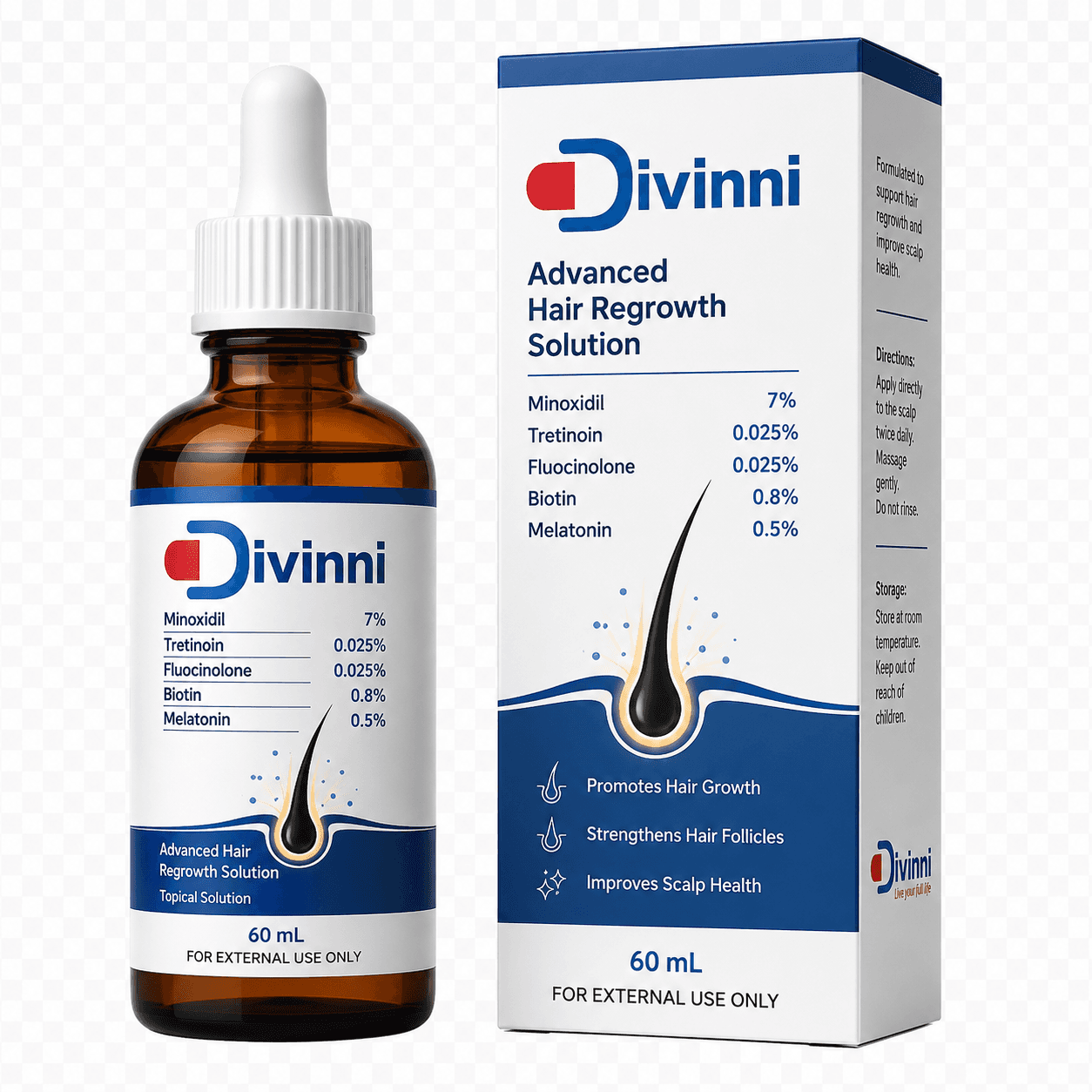
This formulation combines DHT-blocking therapy (finasteride) with growth stimulation (minoxidil), penetration enhancement (tretinoin), and anti-inflammatory support (fluocinolone). It represents a comprehensive topical approach to androgenetic alopecia that addresses multiple pathophysiological mechanisms simultaneously.
Finasteride blocks the conversion of testosterone to DHT by inhibiting the type II 5α-reductase isoenzyme in hair follicles. Topical administration aims to reduce scalp DHT while minimizing systemic absorption .
Composition Overview
This formulation combines DHT-blocking therapy (finasteride) with growth stimulation (minoxidil), penetration enhancement (tretinoin), and anti-inflammatory support (fluocinolone). It represents a comprehensive topical approach to androgenetic alopecia that addresses multiple pathophysiological mechanisms simultaneously.
- Typical Concentration Range:
- Minoxidil: 5-7.5%
- Tretinoin: 0.01-0.025%
- Fluocinolone: 0.01%
- Finasteride: 0.1-0.25%
Individual Ingredient Analysis
Finasteride blocks the conversion of testosterone to DHT by inhibiting the type II 5α-reductase isoenzyme in hair follicles. Topical administration aims to reduce scalp DHT while minimizing systemic absorption .
In a phase III randomized controlled trial, topical finasteride significantly improved hair count compared to placebo, with improvement similar to oral finasteride, but with lower systemic DHT reduction (34.5% vs. 55.6%) .
As detailed in Article 2, minoxidil promotes hair growth through potassium channel activation, VEGF production, and blood flow enhancement. The combination with finasteride addresses both the hormonal (DHT) and vascular/blood flow contributors to hair loss .
Tretinoin enhances the penetration of both minoxidil and finasteride through the stratum corneum. This is particularly important for finasteride, which has higher molecular weight than minoxidil. Additionally, tretinoin has direct effects on keratinocyte differentiation that may support follicle health .
Fluocinolone is a topical corticosteroid that reduces scalp inflammation. Perifollicular inflammation is increasingly recognized as a contributor to follicular miniaturization in androgenetic alopecia, and addressing it may improve outcomes .
- Finasteride (DHT Blocker):
- Topical vs. Oral Finasteride:
- Minoxidil (Growth Stimulant):
- Tretinoin (Penetration Enhancer):
- Fluocinolone (Anti-inflammatory):
Clinical Evidence for Combination
A study of 40 male patients treated with a topical solution of 0.25% finasteride mixed with 3% minoxidil versus 3% minoxidil alone reported superior effects on hair diameter and density with the combination. No systemic adverse events or sexual dysfunction were reported .
- Topical Finasteride + Minoxidil Combination:
- Comparative Efficacy (12-month outcomes):
- 5% topical minoxidil alone: 59% improvement
- 1 mg oral finasteride: 80.5% improvement
- Combination therapy: 94.1% improvement
Why Compounded Topical?
- The rationale for using a compounded topical formulation containing finasteride rather than oral finasteride includes:
- Reduced Systemic Exposure: Topical administration significantly lowers serum DHT reduction (34.5% vs. 55.6% with oral), potentially reducing the risk of sexual side effects .
- Targeted Delivery: Direct application to the scalp concentrates medication where it is needed.
- Combination Convenience: A single product containing multiple active ingredients improves adherence compared to using separate products.
- Non-Responder Option: Patients who cannot tolerate oral finasteride due to side effects may tolerate topical finasteride.
Stability Considerations
Compounded formulations require stability testing. A formulation containing finasteride 0.1%, minoxidil 1.0%, and tretinoin 0.01% was found to be stable for 14 days in one study . Higher concentration formulations may have different stability profiles; patients should follow pharmacy-specific storage and expiration guidance.
Health and Wellness Considerations
The comprehensive approach of this formulation addresses the multifactorial nature of androgenic alopecia, potentially leading to superior clinical outcomes. Successful hair loss treatment is associated with improved quality of life, self-esteem, and reduced anxiety about appearance .
The lower systemic absorption of topical finasteride compared to oral administration offers a favorable safety profile, though some systemic absorption does occur. Patients should be monitored for any signs of sexual dysfunction, though incidence appears lower than with oral finasteride .
- Psychological Impact:
- Systemic Safety:
References
Alhabeeb, S., et al. (2025). Pharmacological Role and Clinical Applications of 5α-Reductase Inhibitors. Saudi Journal of Medicine and Public Health, 2(2), 85-94.
Koralewicz, M.M., & Szatkowska, O.A. (2024). Topical solutions for androgenetic alopecia. Forum Dermatologicum, 10(3), 71-78.
Kegele, C.S., et al. (2025). Personalized Compounded Hair Loss Treatments. International Journal of Pharmaceutical Compounding, 29(3), 239-253.