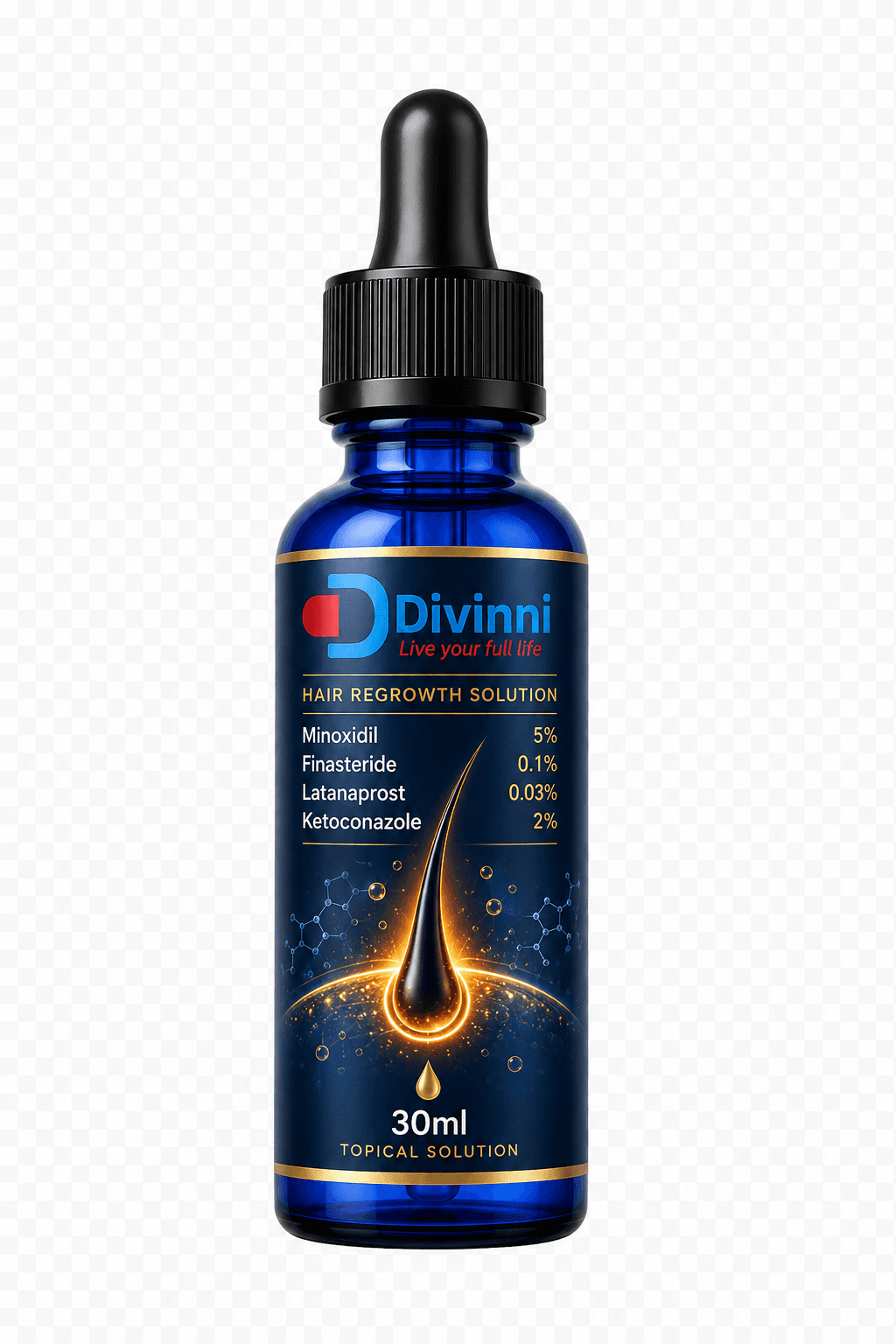
This advanced quadruple-therapy formulation combines four active ingredients targeting distinct pathways in androgenetic alopecia pathogenesis. It represents one of the most comprehensive topical approaches available, addressing DHT suppression, growth stimulation, prostaglandin modulation, and anti-inflammatory/antifungal effects.
As detailed in Article 2, minoxidil promotes hair growth through KATP channel activation, VEGF production, and increased blood flow to follicles .
Composition Overview
This advanced quadruple-therapy formulation combines four active ingredients targeting distinct pathways in androgenetic alopecia pathogenesis. It represents one of the most comprehensive topical approaches available, addressing DHT suppression, growth stimulation, prostaglandin modulation, and anti-inflammatory/antifungal effects.
- Typical Concentrations (may vary by pharmacy):
- Minoxidil: 5-7%
- Finasteride: 0.1-0.25%
- Latanoprost: 0.005-0.01%
- Ketoconazole: 1-2%
Individual Ingredient Analysis
As detailed in Article 2, minoxidil promotes hair growth through KATP channel activation, VEGF production, and increased blood flow to follicles .
Finasteride inhibits type II 5α-reductase, reducing DHT levels in the scalp and preventing follicular miniaturization .
Latanoprost is a prostaglandin F2α (PGF2α) analog originally developed for the treatment of glaucoma. It was observed to cause increased eyelash growth as a side effect, leading to investigation for scalp hair growth .
- Minoxidil (Growth Stimulant):
- Finasteride (DHT Blocker):
- Latanoprost (Prostaglandin Analog):
- Mechanism in Hair Growth:
- Prostaglandins play important roles in the hair cycle. PGF2α and its analogs:
May counteract the hair cycle-stabilizing effects of certain prostaglandins
Latanoprost has been studied in topical formulations for androgenetic alopecia, though it is not FDA-approved for this indication .
While latanoprost shows promise for hair growth, particularly for eyelash hypotrichosis, evidence for scalp hair growth in androgenetic alopecia is less robust than for minoxidil or finasteride. It is generally considered an adjunctive agent for patients who do not fully respond to first-line therapies .
A systematic review of ketoconazole for AGA treatment, which included five human studies, supports the potential efficacy of ketoconazole shampoo in AGA treatment. Three of those studies evaluated the impact of ketoconazole on hair shaft diameter .
- Clinical Evidence:
- Ketoconazole (Antifungal/Anti-androgen):
- Ketoconazole is an imidazole derivative with three relevant properties for hair loss treatment :
- Antifungal: Effective against Malassezia species, which contribute to dandruff and seborrheic dermatitis—conditions that can exacerbate hair shedding.
- Anti-inflammatory: Reduces scalp inflammation that may contribute to follicular miniaturization.
- Anti-androgenic: Ketoconazole has been shown to inhibit testosterone synthesis and may diminish DHT levels in the scalp, though less potently than finasteride .
- Clinical Evidence for Ketoconazole:
- Stability Data: A formulation containing fluocinolone 0.01% and ketoconazole 2.0% remained stable for 150 days in appropriate vehicles .
Mechanism of Synergy
- The four components target different aspects of hair loss pathogenesis:
Rationale for Quadruple Therapy
Co-existing seborrheic dermatitis or dandruff (ketoconazole addresses both conditions simultaneously)
- This formulation is designed for patients with:
- Advanced or aggressive hair loss not responding to dual therapy (minoxidil + finasteride)
- Non-response to first-line therapies where additional mechanisms may provide benefit
Health and Wellness Considerations
Latanoprost is a prostaglandin analog that can cause eye irritation if transferred from the scalp to the eyes. Patients must wash hands thoroughly after application and avoid contact with eyes.
The inclusion of ketoconazole addresses scalp health directly, which may improve overall hair quality even beyond its effects on androgenetic alopecia. A healthier scalp environment supports optimal follicular function.
- Eye Irritation Risk:
- Scalp Health:
Side Effect Profile
- Latanoprost-specific:
Possible hyperpigmentation of treated skin (rare with topical use)
- Ketoconazole-specific:
Contact dermatitis (rare)
- General topical side effects:
References
Kegele, C.S., et al. (2025). Personalized Compounded Hair Loss Treatments. International Journal of Pharmaceutical Compounding, 29(3), 239-253.
Alhabeeb, S., et al. (2025). Pharmacological Role and Clinical Applications of 5α-Reductase Inhibitors. Saudi Journal of Medicine and Public Health, 2(2), 85-94.
- Koralewicz, M.M., & Szatkowska, O.A. (2024). Topical solutions for androgenetic alopecia: evaluating efficacy and safety. Forum Dermatologicum, 10(3), 71-78.