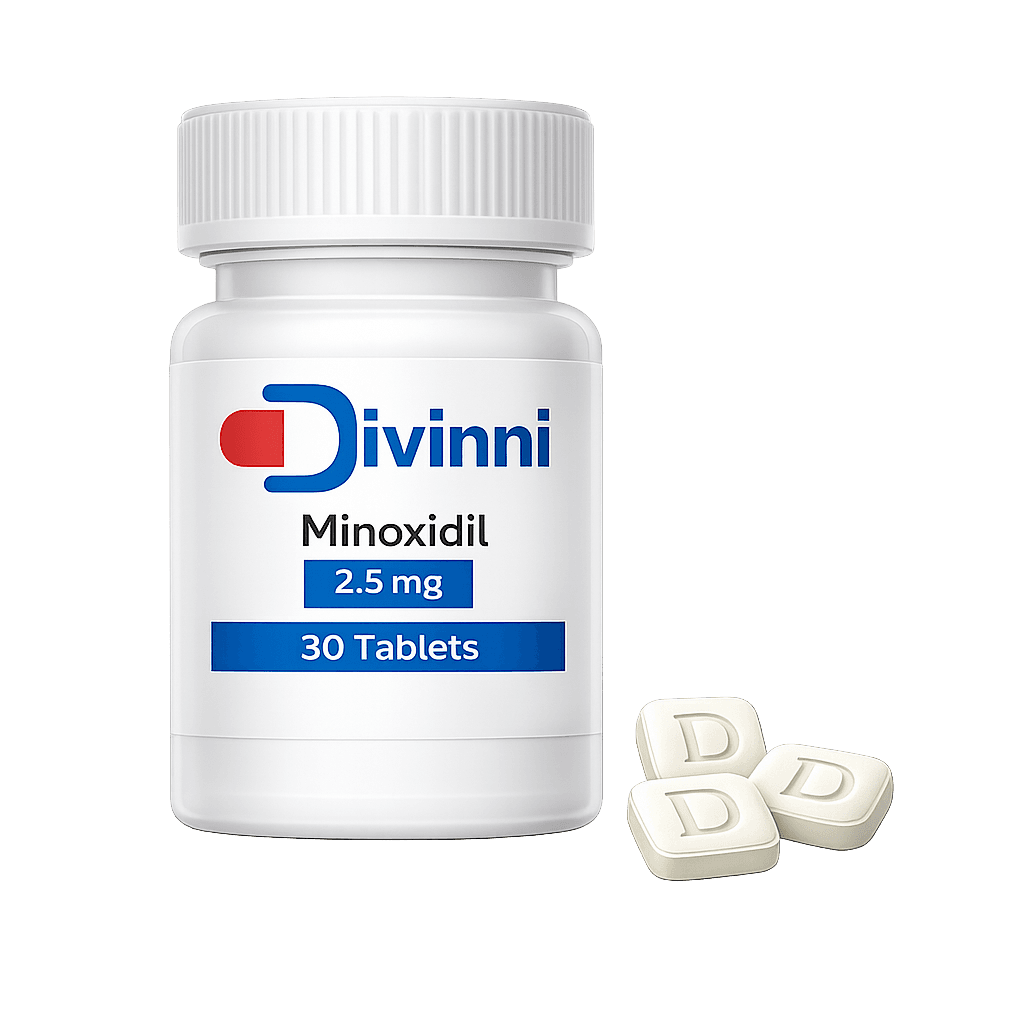
Minoxidil was originally developed as an oral medication for the treatment of hypertension. During clinical trials, a commonly observed side effect was hypertrichosis—excessive hair growth—which led to the development of topical minoxidil for hair loss treatment . Today, topical minoxidil is FDA-approved for androgenic alopecia in both men and women, making it one of the most widely used therapies for hair loss worldwide .
The active metabolite is minoxidil sulfate, which is produced by the enzyme sulfotransferase. Conversion to the active form is higher in hair follicles than in surrounding skin. Importantly, individual variation in follicular sulfotransferase activity explains why some patients respond better to minoxidil than others .
Scientific Background
Minoxidil was originally developed as an oral medication for the treatment of hypertension. During clinical trials, a commonly observed side effect was hypertrichosis—excessive hair growth—which led to the development of topical minoxidil for hair loss treatment . Today, topical minoxidil is FDA-approved for androgenic alopecia in both men and women, making it one of the most widely used therapies for hair loss worldwide .
The active metabolite is minoxidil sulfate, which is produced by the enzyme sulfotransferase. Conversion to the active form is higher in hair follicles than in surrounding skin. Importantly, individual variation in follicular sulfotransferase activity explains why some patients respond better to minoxidil than others .
- Mechanism of Action:
- Minoxidil's hair growth-promoting effects are mediated through multiple pathways:
- Potassium Channel Activation: The primary mechanism involves the activation of ATP-sensitive potassium channels (KATP) in dermal papilla cells. This causes smooth muscle relaxation in blood vessels, increasing blood flow and oxygen delivery to hair follicles .
- VEGF Production: Minoxidil increases the production of vascular endothelial growth factor (VEGF), a potent vasodilator and stimulator of angiogenesis that supports follicle health .
- Anti-inflammatory Effects: Minoxidil reduces perifollicular microinflammation, which contributes to follicular miniaturization .
- Cell Cycle Effects: Topical application of minoxidil increases the count of hairs in the anagen (growth) phase and decreases hairs in the telogen (resting) phase .
Efficacy for Hair Loss Treatment
Topical minoxidil remains the only FDA-approved treatment for androgenic alopecia in both men and women, and is considered first-line therapy .
In a 12-month observational study of 904 male patients with AGA treated with 5% minoxidil solution twice daily, the affected region significantly decreased in size in 62% of patients and became larger in only 2.9% of subjects. Overall, 84.3% of patients reported hair regrowth of various degrees .
A 48-week randomized controlled trial of 352 males with AGA found that 5% minoxidil solution produced 45% more hair regrowth than the 2% solution. An earlier response was also noted, with non-vellus hair count at 8 weeks equivalent to 16 weeks of treatment with 2% minoxidil .
- Topical Minoxidil (First-Line Therapy):
- Clinical efficacy data:
- Concentration Comparison:
- Oral Minoxidil (Off-Label):
- Low-dose oral minoxidil has gained recognition as an off-label treatment for hair loss disorders, including androgenetic alopecia, telogen effluvium, and alopecia areata . Advantages over topical administration include:
Consistent systemic absorption
- Standardized Dosing (International Delphi Consensus) :
- Women starting dose: 1.25 mg/day (range 0.625-5 mg/day)
- Men starting dose: 2.5 mg/day (range 1.25-5 mg/day)
Caution advised in renal/hepatic impairment
- Contraindications for Oral Minoxidil :
Pregnancy
Sublingual administration is a novel delivery route that bypasses first-pass metabolism in the liver. Early evidence indicates similar efficacy to oral therapy with a potentially lower risk of cardiovascular effects, though further large-scale studies are needed .
- Sublingual Minoxidil (Investigational):
Health and Wellness Considerations
- Cardiovascular Effects:
- At the low doses used for hair loss (1.25-5 mg daily), cardiovascular side effects are uncommon . However, at the higher doses originally used for hypertension (up to 40 mg daily), minoxidil can cause:
Pericardial effusion (rare)
The low-dose regimen for hair loss has a favorable cardiovascular safety profile, though patients with pre-existing heart conditions should be monitored.
The most common side effect of oral minoxidil is hypertrichosis—unwanted hair growth on the face, arms, legs, or other body areas. Incidence is dose-dependent and reported at approximately 24% in clinical studies . This effect is generally reversible upon dose reduction or discontinuation.
A temporary increase in hair shedding—often called the "dread shed"—is common during the first 3-5 weeks of minoxidil therapy . This represents the synchronization of hair cycles as telogen (resting) hairs are shed to make way for new anagen (growing) hairs. Patients should be advised to continue therapy despite this temporary effect, as it is a sign the medication is working .
- Hypertrichosis (Unwanted Hair Growth):
- Transient Shedding (Dread Shed):
Combination Therapy Approaches
Combination therapy yields superior results compared to either treatment alone. One comparative study reported 94.1% improvement rates with combination therapy versus 80.5% with finasteride alone and 59% with minoxidil alone .
Tretinoin (a vitamin A derivative) enhances minoxidil penetration and efficacy. Clinical studies have reported that combined minoxidil and tretinoin once-daily works as well as traditional 5% minoxidil twice-daily therapy, effectively doubling the efficiency of minoxidil .
- Minoxidil + Finasteride:
- Minoxidil + Tretinoin:
Safety and Side Effects
- Topical Minoxidil Side Effects :
Facial hypertrichosis (more common with higher concentrations)
- Oral Minoxidil Side Effects :
Mild peripheral edema (2%)
- Rare: Pericardial effusion, ECG changes
References
Koralewicz, M.M., & Szatkowska, O.A. (2024). Topical solutions for androgenetic alopecia. Forum Dermatologicum, 10(3), 71-78.
- Dias, F.R., et al. (2026). Expanding the therapeutic landscape of minoxidil for androgenetic alopecia: topical, oral and sublingual formulations. Frontiers in Pharmacology, 16.
- Oral Minoxidil for Alopecia Treatment: Risks, Benefits, and Recommendations. (2026). American Journal of Clinical Dermatology, 27, 101-119.