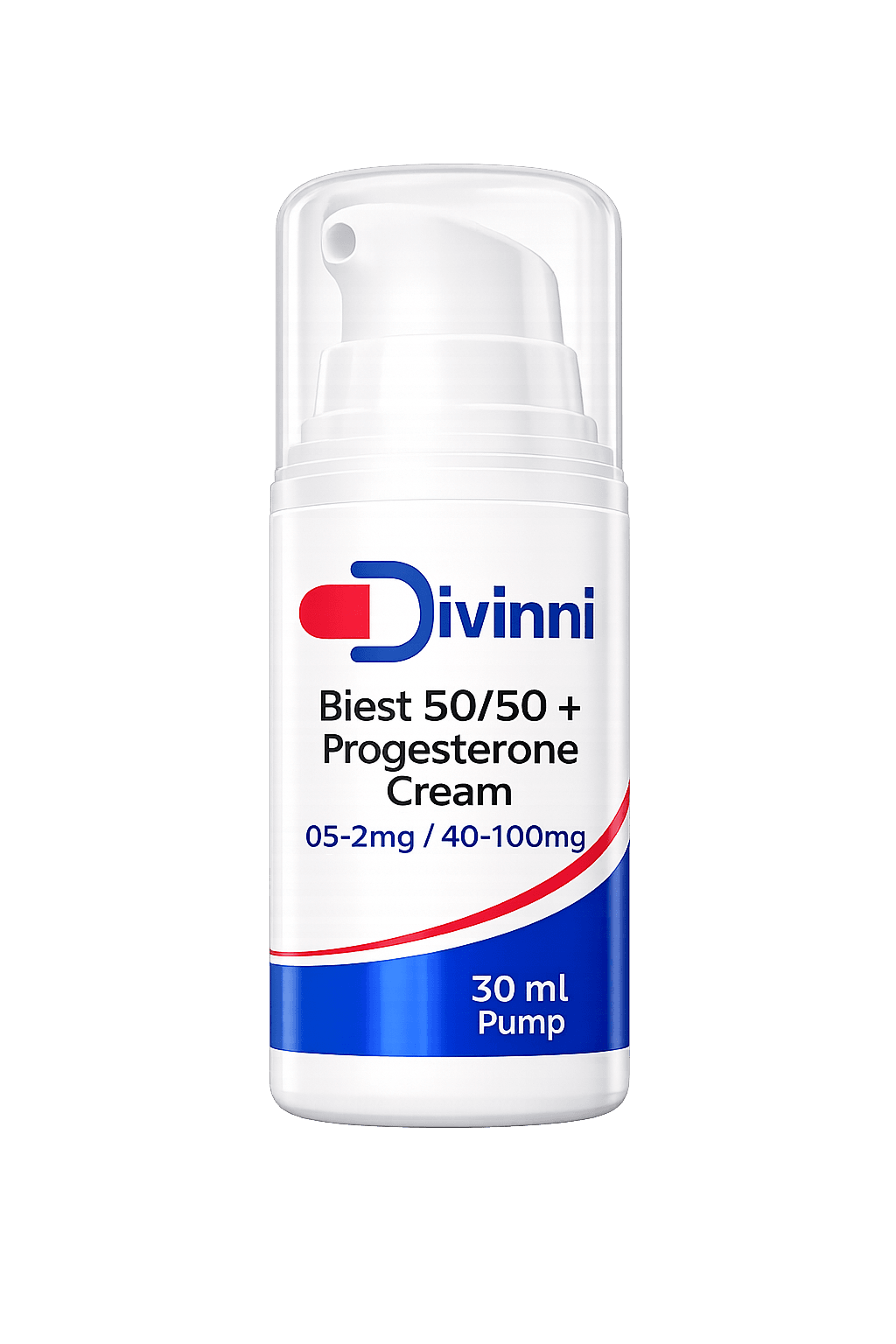
When most people think of topical treatments for erectile dysfunction (ED), they imagine vasodilators like alprostadil creams that work directly on penile blood vessels. However, a fundamentally different approach exists: hormonal restoration therapy using a combination of estriol, progesterone, and testosterone.
This article explains the science behind this unique formulation and how it differs from conventional ED treatments.
Part I: The Hormonal Imbalance Theory of ED
A critical fact about male sexual health: erectile dysfunction is often hormonal in origin. A 2025 multicenter PubMed study involving 411 men found total and free testosterone levels are significantly associated with ED severity — total testosterone falling from a median of 7.05 ng/mL in men with normal function to 3.56 ng/mL in severe ED. All ED groups had median free testosterone below the normal minimum threshold.
For many men, ED is not primarily a blood flow problem — it is a hormone deficiency problem. Hormone deficiencies cannot be fixed with Viagra alone.
Researchers have also identified abnormal progesterone levels in men with ED. Patent literature notes that correcting progesterone and testosterone toward normal values helped most study participants obtain normal erectile function. The central premise: restoring hormonal balance rather than forcing vasodilation.
Part II: The Three Components and Their Roles
Testosterone is the fundamental male sex hormone for libido, erectile function, and sexual health. Low testosterone links to reduced desire, fewer spontaneous erections, and diminished erectile response. Topical delivery bypasses first-pass liver metabolism, providing more stable levels when applied to hairless skin (inner arms, chest, neck).
Critical safety note: topical testosterone can harm women and children who contact treated skin. Users must allow the cream to dry, cover the area, and wash hands thoroughly.
Progesterone inhibits conversion of testosterone to DHT via 5-alpha reductase (up to 10-fold reduction in DHT formation), may decrease aromatase activity preserving testosterone, and may correct progesterone deficiency observed in some men with ED.
Estriol is a weak estrogen with shorter duration than estradiol. Its role in male sexual health is less studied — inclusion appears based on theoretical hormonal balancing (modulating androgen metabolism, addressing estrogen dominance with aging, potential prostate considerations) rather than robust clinical trials specific to estriol in male ED.
- Testosterone: restores libido and baseline erectile physiology; requires medical monitoring.
- Progesterone: anti-androgen balancer — limits excessive DHT while supporting testosterone preservation.
- Estriol: least substantiated component; theoretical balancing role with limited male-specific evidence.
Part III: How This Combination Differs from Conventional ED Treatments
Hormonal Cream vs. PDE5 Inhibitors
| Feature | PDE5 Inhibitors (Viagra, Cialis) | Hormonal Restoration Cream |
|---|---|---|
| Primary mechanism | Vasodilation (blood flow) | Hormonal balance restoration |
| Onset of action | 30–60 minutes | 3 weeks to 3 months |
| Duration of effect | Hours (4–36 hours) | Long-term with continued use |
| Requires sexual arousal | Yes | No (restores baseline function) |
| Addresses libido | No | Yes (testosterone increases desire) |
| Treats underlying cause | No (symptom management) | Yes (corrects deficiency) |
| Side effect profile | Headache, flushing, nasal congestion | Skin irritation, hormonal side effects |
Part IV: Clinical Evidence
A two-year study of 20 men aged 21–88 evaluated bio-identical progesterone/testosterone cream. Patients had multiple comorbidities (hypertension, BPH, diabetes, cardiovascular disease, and more). Authors reported tremendous success correcting ED despite co-existing illness, with improvement in as little as three weeks to six months (average two to three months).
Important limitation: small sample (n=20), not placebo-controlled, reported in patent documentation rather than peer-reviewed journals — results should be considered preliminary.
A 1983 Archives of Sexual Behavior case report described a bilaterally castrated 48-year-old man on estrogen-progestin treatment who maintained satisfactory sexual behavior and normal-range erectile responses — suggesting progesterone and estrogen may support function even with minimal androgen, though authors cautioned results may not generalize.
Patent literature also cites DHT as potentially important for orgasm frequency and prevention of erectile failure, with the formulation designed to raise DHT effectively while limiting excessive prostate-driving conversion.
Part V: Proposed Benefits of This Cream
- Restoration of morning erections — a marker of physiological rather than medication-dependent function.
- Enhanced libido — testosterone directly increases desire, unlike PDE5 inhibitors.
- Treatment at the source — aims to correct hormonal deficiency rather than temporarily bypass it.
- Convenient once-daily topical application not timed to sexual activity.
- Potential prostate protection — progesterone may limit excessive testosterone-to-DHT conversion.
Part VI: Important Limitations and Cautions
- Limited rigorous data — primary evidence from a small non-peer-reviewed study and theoretical principles.
- Not FDA-approved for ED — typically compounded from specialty pharmacies.
- Testosterone risks: decreased sperm count, breast enlargement, urinary symptoms, clot risk, acne, headaches, skin irritation.
- Secondary transfer risk to women and children through skin contact requires strict precautions.
- Progesterone lowers DHT while DHT also supports sexual function — optimal balance is undefined.
- Estriol's role is the least proven of the three components.
- Not intended for primarily psychogenic ED — patent study excluded psychogenic cases.
Conclusion
The estriol/progesterone/testosterone cream represents a fundamentally different approach than PDE5 inhibitors — aiming to restore hormonal balance rather than temporarily force vasodilation. Testosterone deficiency is strongly associated with ED severity; progesterone may limit harmful DHT conversion while preserving androgen activity; estriol's role remains least substantiated.
Patients should hold appropriate expectations. Evidence is limited to a small non-peer-reviewed study, a single castration case report, and theoretical hormonal principles. Significant safety considerations apply, including testosterone therapy risks and secondary transfer.
For men with confirmed hormonal abnormalities who have not responded to conventional ED treatments, this may be a reasonable option under physician supervision — but it is not first-line therapy and is not appropriate for normal hormone levels or psychogenic ED. Treatment should be guided by baseline and follow-up hormone testing with a provider who understands both potential benefits and evidence limitations.
Sources
- United States Patent US6743448B2. Topical Hormonal Formulation for Male Sexual Dysfunction. 2004.
- Davidson JM, et al. Maintenance of sexual function in a castrated man treated with ovarian steroids. Arch Sex Behav. 1983.
- United States Patent Application US20070167418A1. Progesterone/Testosterone Cream for Erectile Dysfunction. 2007.
- Canadian Patent Application CA2431566A1. Hormonal Formulation for Male Sexual Dysfunction.
- MedlinePlus. Testosterone Topical Drug Information. 2025.
- Hormones, Age, and Erectile Dysfunction: Should Routine Testing Be Part of the Initial Evaluation? PubMed. 2025.