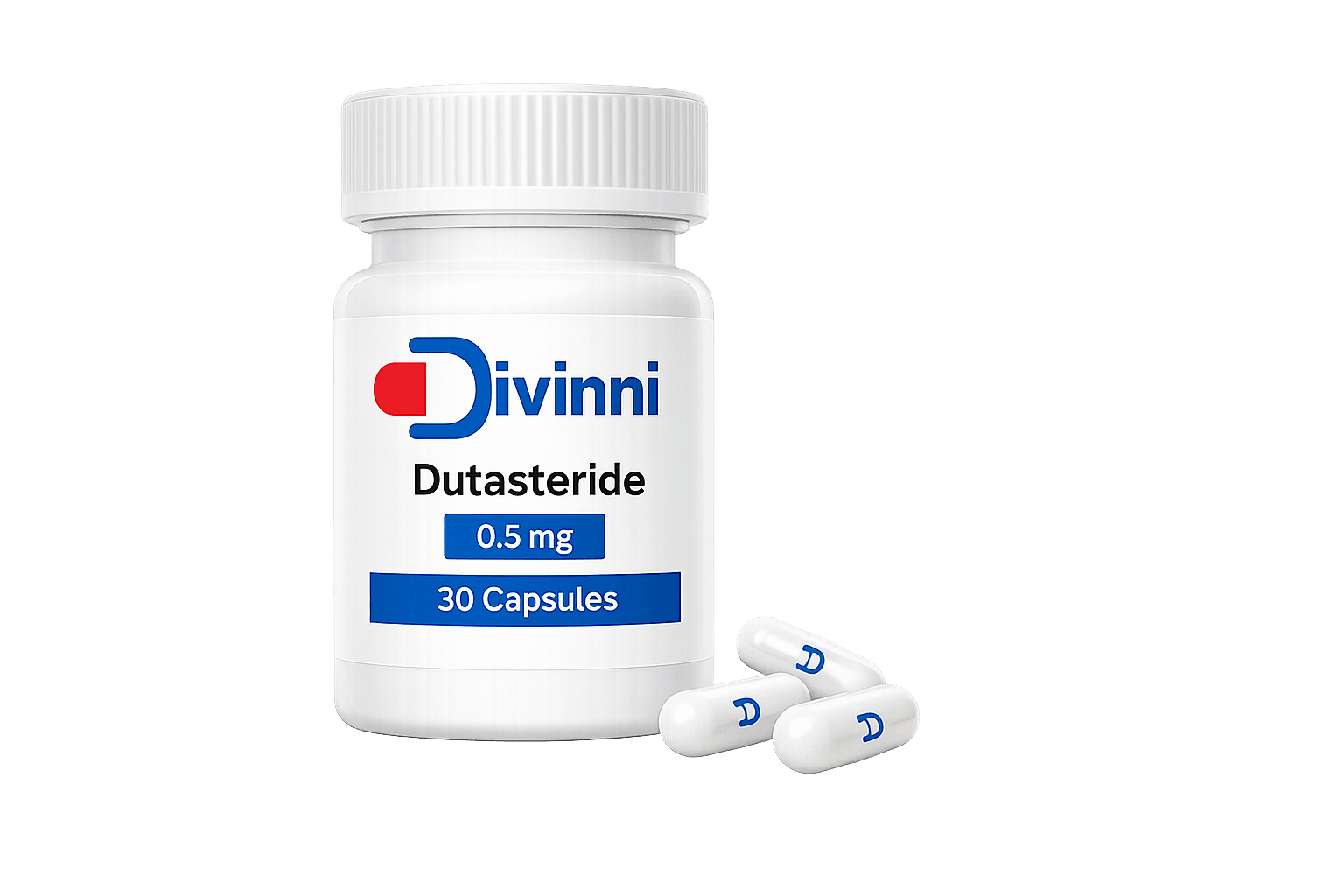
Dutasteride is a dual 5α-reductase inhibitor that blocks both type I and type II isoenzymes of the 5α-reductase enzyme . This distinguishes it from finasteride, which selectively inhibits only the type II isoenzyme. By inhibiting both isoforms, dutasteride achieves more complete suppression of dihydrotestosterone (DHT) production.
Dutasteride is FDA-approved for the treatment of benign prostatic hyperplasia (BPH, enlarged prostate) but is not FDA-approved for hair loss . However, it is frequently prescribed off-label for androgenic alopecia, particularly in men who have not responded adequately to finasteride or who have aggressive hair loss.
Scientific Background
Dutasteride is a dual 5α-reductase inhibitor that blocks both type I and type II isoenzymes of the 5α-reductase enzyme . This distinguishes it from finasteride, which selectively inhibits only the type II isoenzyme. By inhibiting both isoforms, dutasteride achieves more complete suppression of dihydrotestosterone (DHT) production.
Dutasteride is FDA-approved for the treatment of benign prostatic hyperplasia (BPH, enlarged prostate) but is not FDA-approved for hair loss . However, it is frequently prescribed off-label for androgenic alopecia, particularly in men who have not responded adequately to finasteride or who have aggressive hair loss.
This more complete DHT suppression theoretically translates to superior efficacy for hair loss, though clinical differences may be modest.
- Mechanism of Action:
- Dutasteride inhibits the conversion of testosterone to DHT by binding to both 5α-reductase isoenzymes:
- Type I: Found primarily in skin, scalp, liver, and sebaceous glands
- Type II: Found primarily in prostate, hair follicles, and epididymis
- The dual inhibition results in more profound DHT suppression:
- Finasteride (1 mg): Reduces serum DHT by approximately 65-70%
- Dutasteride (0.5 mg): Reduces serum DHT by approximately 90-95%
Efficacy for Hair Loss Treatment
Research indicates dutasteride may be one of the most effective treatments for male-pattern hair loss . A 2022 study published in the Annals of Dermatology involving 600 men showed that those treated with dutasteride had better hair growth improvement compared to men treated with finasteride .
- Comparative Effectiveness:
- A network meta-analysis of 23 trials identified the following hierarchy of efficacy (from most to least effective) :
2% topical minoxidil
When used for hair loss, the typical dose of oral dutasteride is 0.5 mg once daily—the same dose used for BPH .
Compounding pharmacies can provide topical dutasteride solutions, often at concentrations of 0.1% to 0.25% . These are sometimes combined with minoxidil (to increase blood flow) or tretinoin (to enhance penetration). However, it is important to note that compounded medications, including topical dutasteride, are not FDA-approved for quality or safety and lack clinical trials regarding efficacy .
Like finasteride, dutasteride must be taken on an ongoing basis for sustained benefit. "There is no long-lasting benefit," explains Dr. Lily Chen Greenberg, a board-certified dermatologist. "It's not like an antibiotic where there is a set start and end time" .
- Dosing:
- Topical Dutasteride:
- Time Course and Duration:
Health and Wellness Considerations
The earlier treatment is initiated, the better the outcomes. "The earlier the easier," notes Dr. Greenberg, adding that medication can help thicken existing hair but is more effective when there is more hair to work with from the beginning of treatment .
Dutasteride not only stops hair loss but also allows hairs to increase in diameter, resulting in thicker, fuller-looking hair .
- Onset of Action:
- Hair Quality Improvement:
Safety and Side Effects
- Important Precautions:
- PSA Interference: Dutasteride can interfere with PSA (prostate-specific antigen) results—a blood test used to detect prostate cancer. This is one of the most important considerations for men considering dutasteride therapy .
- Long Half-Life: Dutasteride has a long half-life (approximately 5 weeks), meaning it stays in the body for nearly six months after discontinuation . This has implications for:
Timing of fertility planning
- Sexual Side Effects:
Reduced sperm count
- Other Possible Side Effects:
Male breast enlargement (gynecomastia)
Dutasteride is primarily for men. "Data is limited on dutasteride for female-patterned hair loss," says Dr. Greenberg. "Oral dutasteride is not first line in my practice, especially in premenopausal females, because of its long half-life and its contraindication in pregnancy due to its effect on genital development in male fetuses" .
- Use in Women:
When to Consider Dutasteride
- Given its more potent DHT suppression and longer half-life, dutasteride is generally reserved for:
References
Alhabeeb, S., et al. (2025). Pharmacological Role and Clinical Applications of 5α-Reductase Inhibitors. Saudi Journal of Medicine and Public Health, 2(2), 85-94.
- Forbes Health. (2026). Dutasteride For Hair Loss: Side Effects, Dosage And More.